Human-in-the-Loop Automation: Building Trustworthy Systems with OCTO

Why Human-in-the-Loop Matters
As organizations accelerate their digital transformation journeys, automation offers speed, scalability, and consistency. However, real-world business processes are rarely black and white. Complex decisions, nuanced judgment, and compliance considerations often require a human touch.
This is where Human-in-the-Loop (HITL) automation comes in. By combining automation with human expertise, organizations can achieve the best of both worlds, machines deliver efficiency, while humans provide oversight, adaptability, and trust.
Rather than replacing people, HITL redefines roles:
• Automation handles repetitive, rules-based tasks at scale.
• Humans focus on higher-value work, strategic thinking, complex analysis, compliance, and customer care.
• The result is not just operational efficiency but a smarter, more empowered workforce.
Intelligent Task Routing with OCTO
Automation is most effective when it knows when to hand over to a human. OCTO’s intelligent task routing ensures that human intervention happens at precisely the right time and by the right person.
Tasks are dynamically assigned based on role, expertise, workload, and business rules. For instance:
• A compliance-related task routes directly to a compliance officer.
• Automated flagging and routing cases for human review when automation detects potential business risk.
• An invoice anomaly goes to the finance expert best equipped to resolve it.
• Application information mismatching
This approach prevents bottlenecks, maintains flow, and keeps human experts focused where their input truly adds value.
Studies support this approach: 86% of service leaders using AI plus HITL, report improved customer satisfaction, and 92% see faster response times.(1) Hybrid human-and-AI models have also been shown to match or surpass human-only performance in service quality.
Exception Handling: Turning Edge Cases into Strengths
In many systems, exceptions are treated as failures, moments when automation stops. OCTO flips that perspective.
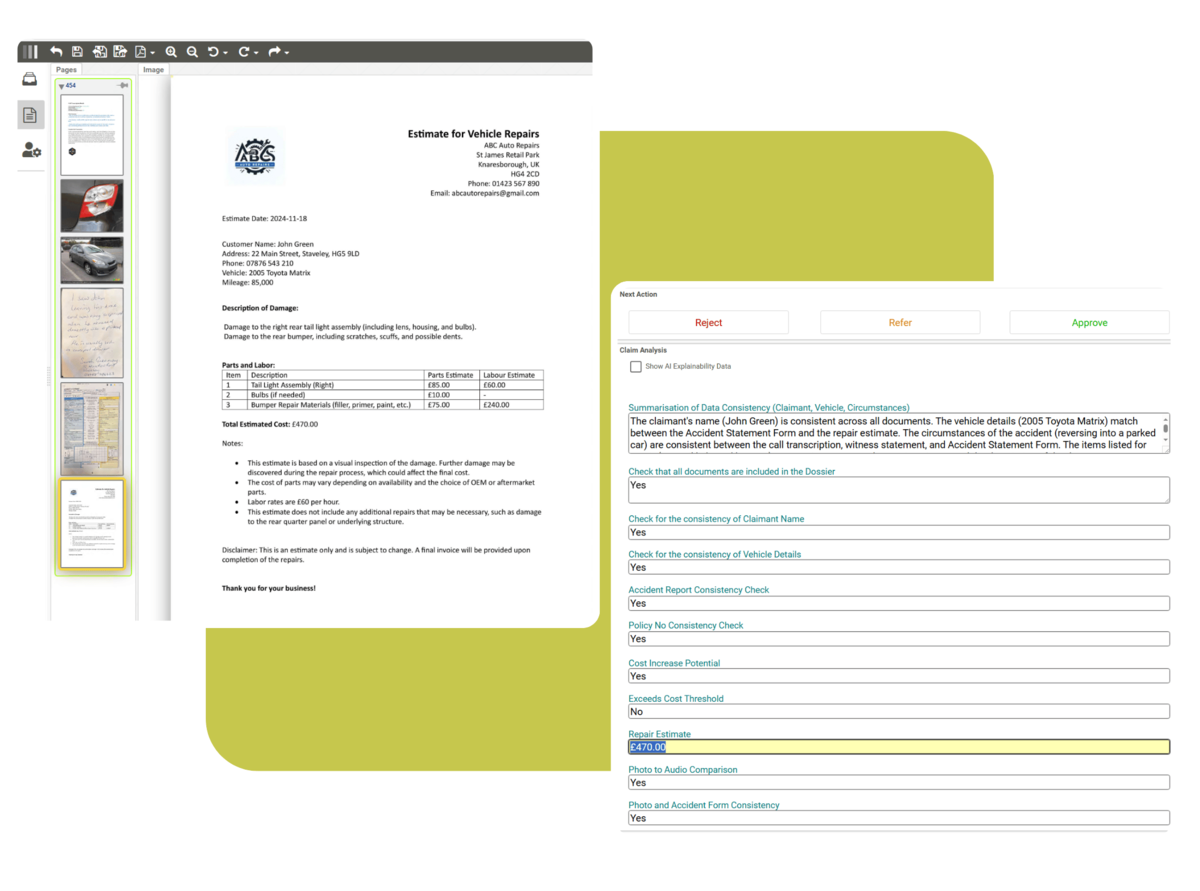
When anomalies occur such as a nonstandard contract clause or an out-of-range insurance claim, OCTO seamlessly brings in the right human to make the call. Rather than halting the process, exceptions become opportunities for human expertise to enhance quality and compliance.
This builds confidence in automation. Users trust that the system won’t fail silently, instead, it intelligently involves them when needed.
Benchmarks show that in intelligent document processing, accuracy can rise from ~80% to over 95% when human validation is integrated.(5)
Continuous Improvement Through Feedback Loops
Every time a human adjusts a value, OCTO learns. Each correction, whether updating a header field, confirming a date, or fixing a reference number, is captured and used to refine extraction logic and automation behavior.
Rather than treating corrections as one-off fixes, OCTO records the context behind each adjustment. This includes factors such as supplier, document layout, format, and field position, allowing the platform to recognize patterns over time.
For example:
If an invoice date or total amount is mis-extracted and an operator corrects the value, once that correction is confirmed, OCTO captures the pattern behind the error. When similar invoices from the same supplier, layout, or format are processed in future, the platform automatically applies the learned correction, reducing or eliminating the need for repeated manual intervention.
This creates a closed feedback loop that continuously improves performance:
1. Automation extracts and validates invoice data.
2. Operators correct or confirm exceptions.
3. Corrections are captured and analyzed.
4. Extraction logic adapts and improves automatically.
Over time, extraction accuracy increases, exception rates fall, and the system becomes progressively more aligned with real-world invoice behavior, delivering higher straight-through processing with less human effort.
The Business Value of HITL Automation
The power of HITL lies in its balance between efficiency and assurance. Automation provides speed, consistency, and scalability, while human oversight ensures accuracy, adaptability, and compliance.
Key benefits include:
• Reduced risk: Human validation prevents costly errors and compliance breaches.
• Increased trust: Stakeholders gain confidence in automated outcomes.
• Higher ROI: Efficiency gains are sustained through continuous learning.
• Employee empowerment: Teams spend more time on strategy, creativity, and problem-solving.
This synergy, automation driving efficiency, humans reinforcing trust, transforms processes into resilient, future-ready systems that scale intelligently without sacrificing control.
OCTO: Automation You Can Trust
Automation without human input is risky. Manual work without automation is unsustainable. OCTO’s Human-in-the-Loop framework unites both, ensuring every process step is handled by the most capable “agent,” whether human or machine.
• Automation delivers speed, consistency, and scale.
• Humans ensure adaptability, compliance, and confidence.
• OCTO orchestrates the balance, intelligently, transparently, and at enterprise scale.
The future of automation isn’t about replacing people, it’s about empowering them. With OCTO, organizations move beyond simple process automation to create trustworthy, human-centered systems built for the real world.
Automation shouldn’t just work faster, it should work smarter, and earn trust every step of the way.
With OCTO, every correction makes the system better, every decision strengthens accuracy, and every process becomes more human-centered over time.
References
1. HubSpot, State of Service 2024: 86% say AI boosts CSAT; 92% say AI improves response times.
2. Journal of Retailing & Consumer Services (2024): Chatbot + light human intervention matched human-only service quality.
3. Atlassian (Jira) best practices: SLA monitoring & escalation.
4. ServiceNow Australia: Automated escalation for SLA prioritization.
5. Parseur (IDP benchmarks): Accuracy improves from ~80% to 95%+ with human validation.
