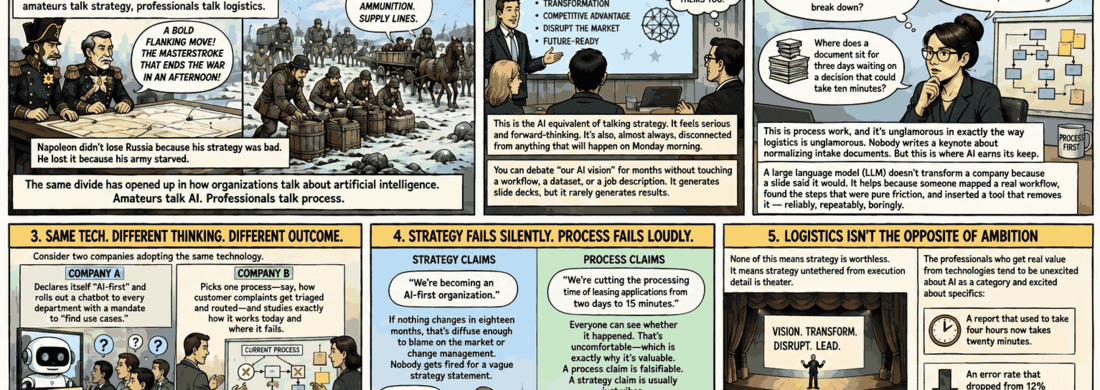
Organizations often spend too much time debating AI strategy and too little time improving the processes where AI can create measurable value. This article argues that successful AI adoption starts with specific workflows, clear ownership, measurable failure points, and practical execution. Rather than pursuing vague “AI-first” ambitions, companies should identify operational friction, redesign processes, and apply AI where it can reliably reduce time, errors, and unnecessary work.
Enterprise AI becomes operational when it is embedded in a governed, measurable business process. Neil Walker, TCG Process Head of Product, explains how process orchestration with OCTO connects AI, data, rules, systems and human work to turn isolated experiments into robust, explainable automation that delivers measurable business value.
See how enterprises can orchestrate multiple AI models with OCTO to balance cost, performance, governance and flexibility without rebuilding business processes.
Most organizations have solid systems of record. The problem is asking them to do work they were never designed for. This article explores why introducing a flexible process orchestration layer, rather than overloading core systems, is the key to unlocking genuine operational efficiency.
Human-in-the-loop automation is a design principle, not a workaround. See how the OCTO process orchestration platform routes exceptions to the right person.
Hyperautomation combines intelligent document processing, AI, process orchestration, and integration to automate complete business processes, not only individual tasks. This article explains what hyperautomation means and how it differs from robotic process automation (RPA). It covers six benefits: processing speed, accuracy, scalability, cost efficiency, employee experience, and agility, including how UK insurer ERS increased claim capacity by 75%. It also describes how process orchestration coordinates people, systems, and AI, how to start with one focused, high-impact process, and what to look for in a technology partner.
AI is powerful, but it only scales with governance and process discipline—just like OCR did. Sustainable value comes from orchestrated, contextualized AI with built-in controls and human oversight where risk demands it.
AI alone isn't enough. This article explores how combining intelligent automation with AI serves the process, not the other way around. See how this approach creates value, what technology capabilities matter, and how to implement it without losing control or flexibility.
Learn how DocProStar enables hybrid government—bridging analog and digital channels so public administration can modernize without leaving anyone behind.
See how OCTO and Agentic Document Extraction by LandingAI work together to move AI document processing beyond pilots into production-ready automated workflows.