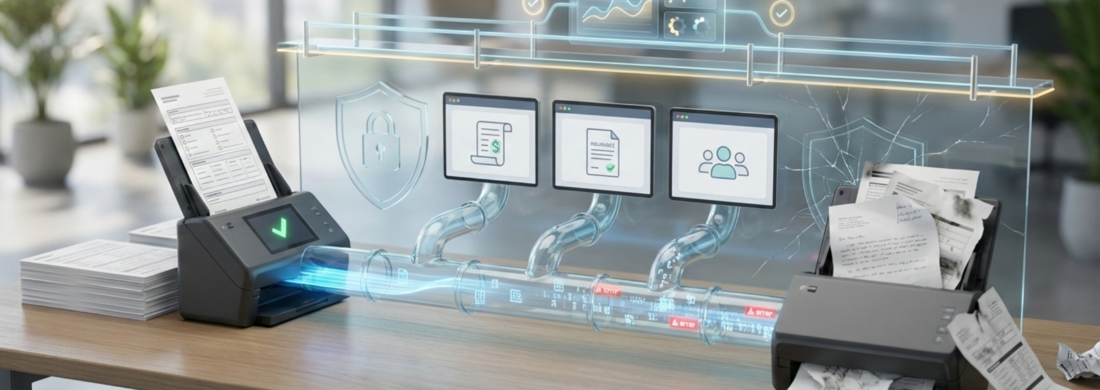
Enterprise AI becomes operational when it is embedded in a governed, measurable business process. Neil Walker, TCG Process Head of Product, explains how process orchestration with OCTO connects AI, data, rules, systems and human work to turn isolated experiments into robust, explainable automation that delivers measurable business value.
Enterprises using AI face growing risks from shadow AI, data exposure, and limited oversight. Learn why AI governance now belongs inside process automation, where business-critical work can be secure, auditable, and accountable.
Most organizations still manage email the way they did a decade ago: manually, inconsistently, and at significant cost. The Email Triage Accelerator, built on OCTO, the no-code process orchestration platform from TCG Process, changes that. Sitting on top of your existing Microsoft 365 environment, it automatically classifies, prioritizes, and routes inbound emails and attachments based on your business rules, reducing human errors and rework by more than 90%. Every step is logged and reportable, implementation takes around five days, and because it runs on OCTO, email triage becomes the natural entry point to enterprise input management.
Most organizations have solid systems of record. The problem is asking them to do work they were never designed for. This article explores why introducing a flexible process orchestration layer, rather than overloading core systems, is the key to unlocking genuine operational efficiency.
Is it time your organization moved past the "Paper" or "PDF" era? Not all AP invoice automation is created equal. To understand where the real ROI lies today, we have to look at how the technology has evolved through three distinct generations.
Discover how artificial intelligence in automation powers smarter processes—and why the platform governing that AI matters just as much as the AI itself.
Human-in-the-loop automation is a design principle, not a workaround. See how the OCTO process orchestration platform routes exceptions to the right person.
Hyperautomation combines intelligent document processing, AI, process orchestration, and integration to automate complete business processes, not only individual tasks. This article explains what hyperautomation means and how it differs from robotic process automation (RPA). It covers six benefits: processing speed, accuracy, scalability, cost efficiency, employee experience, and agility, including how UK insurer ERS increased claim capacity by 75%. It also describes how process orchestration coordinates people, systems, and AI, how to start with one focused, high-impact process, and what to look for in a technology partner.
AI is powerful, but it only scales with governance and process discipline—just like OCR did. Sustainable value comes from orchestrated, contextualized AI with built-in controls and human oversight where risk demands it.
AI alone isn't enough. This article explores how combining intelligent automation with AI serves the process, not the other way around. See how this approach creates value, what technology capabilities matter, and how to implement it without losing control or flexibility.