What Generation is Your AP Invoice Automation?
For most organizations, automating AP invoices is one of the simplest business decisions on the table. It’s a straightforward equation: calculate the opportunity cost of manual data entry versus the savings of an automated system.
But not all automation is created equal. To understand where the real ROI lies today, we have to look at how the technology has evolved through three distinct generations.
The Evolution of AP Automation
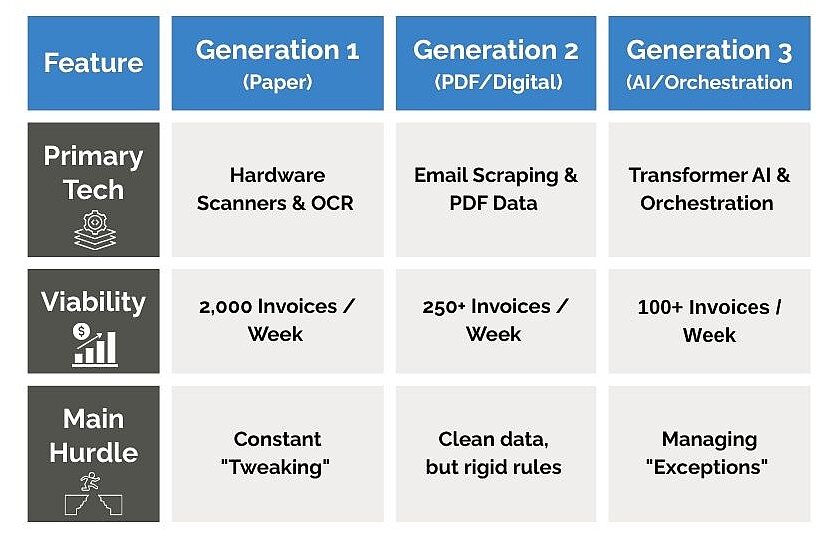
Generation 1: The Paper Era (A "Right Pain")
Two decades ago, paper was the norm. The break-even point was high—typically requiring many hundreds of invoices per week to justify the hardware costs. These systems were built to scan, OCR, and extract, but they were brittle. You spent half your time "babysitting" the software to ensure recognition rates didn’t slump.
Generation 2: The Electronic Tipping Point
Fast forward ten years to the point where emailed PDF attachments overtook paper. Without the inaccuracies of physical scanning, data extraction became "smoother." As hardware costs vanished and competition increased, the ROI improved significantly. However, these systems still struggled when things didn't go exactly to plan.
Generation 3: AI & Process Orchestration
This is where we are today. Two factors make "Generation Three" a game-changer: 1. Transformer AI: Incredibly accurate, cloud-ready engines that understand context, not just characters. 2. Process Orchestration: The "brain" that manages what happens after the data is extracted.
The Power of “Human-in-the-Loop”
In the past, many AP projects stalled because they couldn't replicate the "tacit knowledge" of a human—like spotting a suspicious invoice, a nuanced issue, or knowing what to do with a new supplier. Generation Three systems excel here. They don't just "automate"; they facilitate. Through a configurable "Human-in-the-Loop" interface, the system handles the heavy lifting but flags exceptions for a quick human decision. Ad hoc reviews and data-driven escalations are simple to implement and transform the integrity of the AP process.
The "One-Click" Resolution: Imagine an AP specialist receives an exception. Instead of a manual investigation, they select one of four outcomes. The system then uses AI-driven email generation to draft a perfect explanation to the vendor, explaining exactly what is wrong and how to fix it. Voila—the problem is off their plate in seconds.
Why "Unique" Processes Fail Old Systems: Most organizations believe they have a unique way of doing things. In reality, that "uniqueness" usually comes from running a specific set of applications that amplify small process and policy differences.
Old systems require you to compromise your workflow to fit the software. Generation Three flips the script. By combining process orchestration with flexible AI, it accommodates those small inconsistencies without the need for a total process overhaul.
Is it time your organization moved past the "Paper" or "PDF" era?
Perhaps it’s time to investigate Generation Three.
