Amateurs Talk AI, Professionals Talk Process
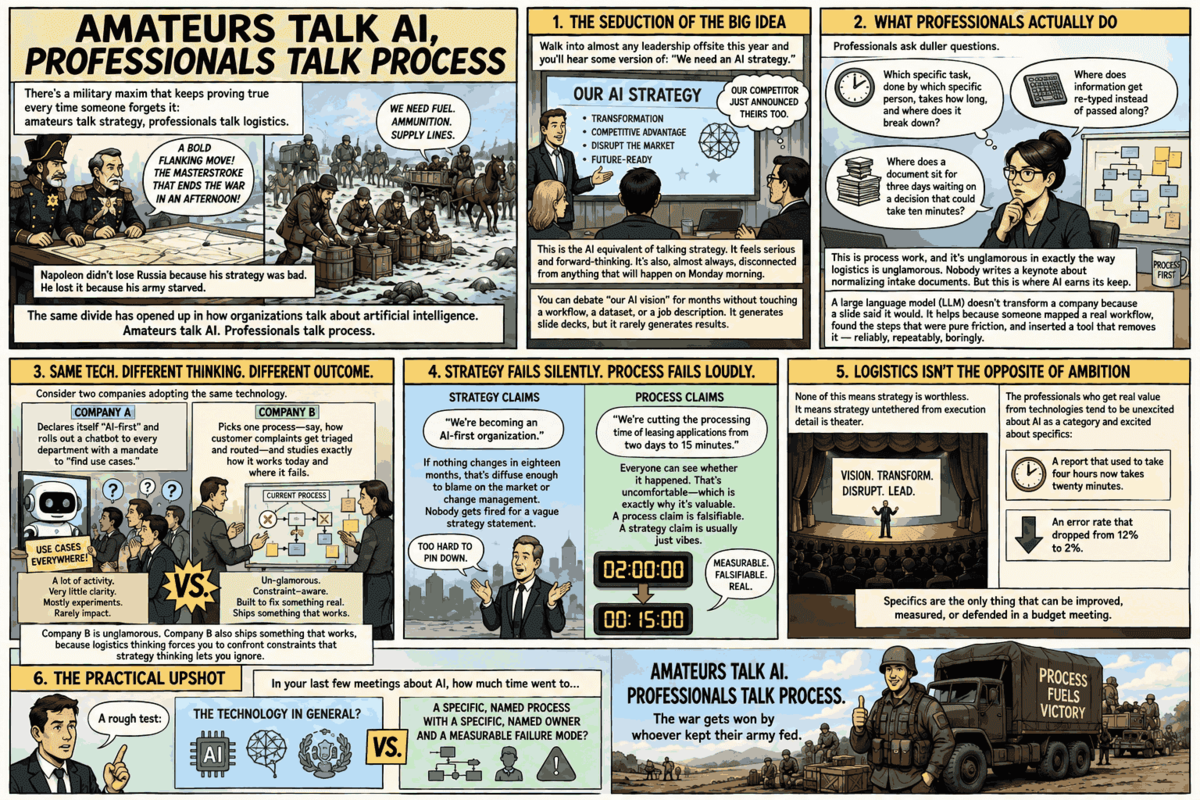
There's a military maxim that keeps proving true every time someone forgets it: amateurs talk strategy, professionals talk logistics. Generals who never wore a uniform love to argue about the bold flanking move, the masterstroke that ends the war in an afternoon. The people who actually win wars talk about fuel, ammunition, and supply lines. Napoleon didn't lose Russia because his strategy was bad. He lost it because his army starved.
The same divide has opened up in how organizations talk about artificial intelligence. Amateurs talk AI. Professionals talk process.
The Seduction of the Big Idea
Walk into almost any leadership offsite this year and you'll hear some version of: "We need an AI strategy." There will be a slide, talk of transformation and competitive advantage, maybe a mention that a competitor just announced their own initiative.
This is the AI equivalent of talking strategy. It feels serious and forward-thinking. It's also, almost always, disconnected from anything that will happen on Monday morning. You can debate "our AI vision" for months without touching a workflow, a dataset, or a job description. It generates slide decks., but it rarely generates results.
What Professionals Actually Do
Professionals ask duller questions. Which specific task, done by which specific person, takes how long, and where does it break down? Where does information get re-typed instead of passed along? Where does a document sit for three days waiting on a decision that could take ten minutes?
This is process work, and it's unglamorous in exactly the way logistics is unglamorous. Nobody writes a keynote about normalizing intake documents. But this is where AI earns its keep. A large language model (LMM) doesn't transform a company because a slide said it would. It helps because someone mapped a real workflow, found the steps that were pure friction, and inserted a tool that removes it — reliably, repeatably, boringly.
Consider two companies adopting the same technology. Company A declares itself "AI-first" and rolls out a chatbot to every department with a mandate to "find use cases." Company B picks one process — say, how customer complaints get triaged and routed — and studies exactly how it works today and where it fails. Company B is unglamorous. Company B also ships something that works, because logistics thinking forces you to confront constraints that strategy thinking lets you ignore.
Strategy Fails Silently. Process Fails Loudly.
The strategy conversation is popular partly because it's hard to be proven wrong. Say "we're becoming an AI-first organization," and if nothing changes in eighteen months, that's diffuse enough to blame on the market or "change management." Nobody gets fired for a vague strategy statement.
Process thinking offers no such cover. Say "we're cutting the processing of leasing applications from two days to 15 minutes," and everyone can see whether it happened. That's uncomfortable — which is exactly why it's valuable. A process claim is falsifiable. A strategy claim is usually just vibes.
Logistics Isn't the Opposite of Ambition
None of this means strategy is worthless. It means strategy untethered from execution detail is theater. The professionals who get real value from technologies tend to be unexcited about AI as a category and excited about specifics: a report that used to take four hours now takes twenty minutes; an error rate that dropped from 12% to 2%. Specifics are the only thing that can be improved, measured, or defended in a budget meeting.
The Practical Upshot
A rough test: in your last few meetings about AI, how much time went to the technology in general, versus a specific, named process with a specific, named owner and a measurable failure mode? Amateurs talk AI. Professionals talk process. The war gets won by whoever kept their army fed.
