Why Governed AI Will Define the Next Generation of Process Automation

Artificial intelligence has never been more accessible. In just a few years, tools like ChatGPT, Microsoft Copilot, and Google Gemini have moved from curiosity to boardroom staple. Employees across every industry are using them daily to draft emails, summarize reports, analyze data, and accelerate decisions.
The promise is real. The productivity gains are real. But so is the risk, and most organizations are only just beginning to understand what they have already exposed.
In many large enterprises, access to public AI services is restricted and employees are directed toward approved enterprise tools. In others, particularly organizations without mature AI policies and controls, employees may still be using public or personal AI accounts for everyday work. Both situations create governance questions.
When your team pastes a customer contract into ChatGPT to summarize it, where does that data go? When a finance analyst uploads a spreadsheet to Copilot for formatting, who can see it? When HR uses an out-of-the-box AI tool to draft a termination letter, what happens to the employee details embedded in that prompt?
Without approved services, clear policies, and process-level monitoring, the answer, in most cases, is: you don’t know. And that’s the problem.
What “Out-of-the-Box” AI Actually Means for Your Data
Consumer and lightly governed enterprise AI tools are designed to be frictionless. That frictionlessness is precisely what makes them dangerous from a governance standpoint.
When a user interacts with a public or free-tier AI model, their input is typically transmitted to external servers, potentially retained for model training, and visible to the AI provider’s infrastructure. There is little to no visibility for your organization into what was submitted, by whom, and how it was processed.
Research from Harmonic Security analyzing over 22 million enterprise AI prompts found that just six generative AI applications accounted for 92.6% of potential enterprise data exposure. ChatGPT alone was responsible for 71.2% of those exposures, despite representing less than half of total usage volume. Meanwhile, a 2025 LayerX report found that 77% of employees using AI tools shared sensitive company data, often from personal or unmanaged accounts.
Beyond data exposure, there is a second, less visible risk embedded in these tools: AI bias. Out-of-the-box AI models are trained on large datasets that reflect existing human patterns, and those patterns include historical inequities. When an AI tool trained on biased data is used to shortlist job applicants, assess credit risk, triage customer complaints, or prioritize service delivery, those biases can be reproduced and amplified at scale, often invisibly.
Consider a hiring workflow where an AI tool ranks resumes based on language patterns associated with “high performers” in historical data. If those historical high performers skewed toward a particular demographic, the tool may systematically deprioritize candidates from underrepresented groups, without any explicit instruction to do so. Or consider a customer service AI that has been trained on data reflecting prior agent behavior: if certain customer segments historically received slower or lower-quality responses, the model may replicate that disparity at scale. These are not hypothetical risks. They are documented outcomes in organizations that deployed ungoverned AI into consequential workflows without bias auditing or human review checkpoints.
This is not a fringe problem. This is happening right now, in your organization, across your industry.
For executives and boards, this creates a far broader issue than employee misuse of technology. The challenge is operational accountability. If regulators, auditors, customers, or legal teams ask how AI was used, what data was processed, where that data went, and what controls existed at the time, many organizations simply cannot answer with confidence.
In practice, that means AI governance is no longer just an IT or cyber-security concern. It is rapidly becoming a board-level risk tied directly to compliance, operational resilience, reputation, and customer trust.
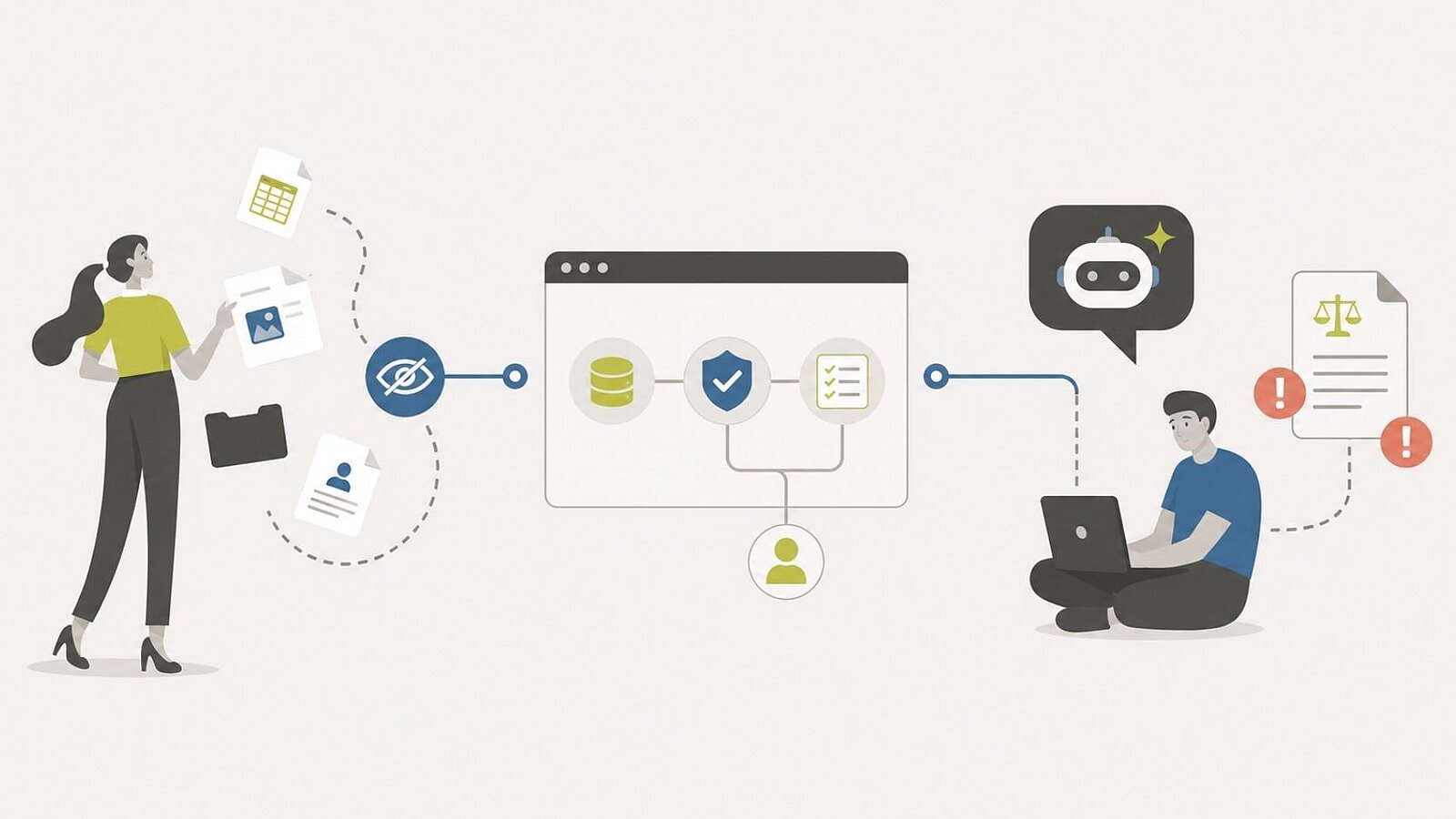
The Three Governance Gaps That Put You at Risk
1. Data Exposure Without Visibility
Artificial intelligence has never been more accessible. In just a few years, tools such as ChatGPT, Microsoft Copilot, and Google Gemini have moved from curiosity to boardroom staple. Employees across every industry are using them to draft emails, summarize reports, analyze data, and make decisions faster.
The promise is real, and so are the productivity gains. But the risks are equally real—and many organizations are only beginning to understand what they may already have exposed.
In many large enterprises, access to public AI services is restricted, with employees directed towards approved enterprise tools. In others, particularly organizations without mature AI policies and controls, employees may still be using public services or personal AI accounts for everyday work. Both situations raise important governance questions.
When someone pastes a customer contract into an AI service for summarization, where is that data processed? When a finance analyst uploads a spreadsheet for formatting or analysis, how is the information protected? When HR uses an out-of-the-box AI tool to draft a termination letter, what happens to the employee details included in the prompt?
Approved enterprise services may provide strong contractual and technical safeguards. But without clear policies, controlled access, and process-level monitoring, an organization may still have no reliable view of which tools are being used, what information is being shared, or whether its controls are being followed.
2. Shadow AI Risk and the Blind Spot in Your Stack
“Shadow AI” is the enterprise equivalent of shadow IT, the phenomenon of employees using unapproved tools without organizational oversight. When sensitive business or customer data moves through tools that IT cannot see, the result is a compliance and security blind spot.
The instinct to block these tools is understandable. But blocking is not the answer. Employees will find workarounds, and organizations will miss the genuine productivity benefits AI can deliver. The answer is not restriction. It is governed enablement.
3. Accountability Gaps and Regulatory Exposure
AI systems that process personal data must comply with GDPR, the Australian Privacy Act, HIPAA, and an expanding landscape of national and sector-specific regulations. Ungoverned AI use can violate requirements around consent, data minimization, purpose limitation, cross-border transfers, and individual rights, often without anyone realizing it until an audit or incident surfaces the issue.
Globally organizations are increasingly expected to demonstrate not only that systems are secure, but that AI-supported processes are controlled, traceable, and auditable. This includes requirements and guidance under frameworks such as the EU AI Act, the US NIST AI Risk Management Framework, the Australian Privacy Act, and APRA CPS 230.
As AI becomes embedded into daily workflows, governed automation is quickly shifting from a technology initiative to an operational resilience requirement.
Why the Solution Is Governed Process Automation:
The answer to the AI governance challenge is not simply finding a slightly safer version of the same AI tool. It is fundamentally changing how AI is deployed, from ad hoc, ungoverned tool use to structured, auditable, process-embedded automation.
What organizations need is not simply another AI tool. They need a governed operational framework where AI becomes one controlled component inside a secure, auditable, orchestrated business process.
This is where TCG Process and OCTO take a fundamentally different approach.
OCTO by TCG Process: Governed AI for the Real World
OCTO is TCG Process’s process automation and orchestration platform, designed around a fundamentally different philosophy for enterprise AI.
Where out-of-the-box AI tools hand capability to the individual and hope for the best, OCTO embeds AI inside a controlled, auditable, governed process. Every action is traceable. Every decision is logged. Every AI output can be validated before it influences a business outcome.
The name itself reflects this philosophy. OCTO derives from the Latin word for eight, representing the platform’s eight core capabilities: Orchestration, Process Management, Intelligent Automation, Security and Compliance, Integration, Scalability, Flexible UI, and Embracing AI.
What Makes OCTO Different
Governed AI at Scale: OCTOai
The OCTOai competency is designed for exactly the challenge described above, bringing trusted, governed AI into business-critical processes with safety and control. It gives organizations the flexibility to deploy, swap, and upgrade AI models and services without disruption, while maintaining transparency, governance, and process integrity throughout.
Full Auditability and Explainability
One of the most significant gaps in out-of-the-box AI is the absence of explainability. When a decision is made, or a recommendation generated, can you explain how that outcome was reached? In a regulatory environment, that is not optional.
OCTO is built with auditability as a core design principle. Every process step produces a detailed audit log. SLA-driven execution ensures accountability at every stage. Human-in-the-loop oversight is built in where business context or risk level demands it.
Human-in-the-Loop Where It Matters
OCTO supports fully automated, human-assisted, and hybrid decisioning. This means AI handles high-volume, low-risk, routine work at scale, while exceptions and high-stakes decisions are routed to human review with full context provided.
Consider a typical insurance or finance workflow. In many organizations today, an employee manually downloads an attachment, uploads it into a public AI tool for summarization or extraction, copies the response into another system, and forwards the result internally. While efficient on the surface, the process creates multiple governance blind spots.
With OCTO, that same workflow operates entirely within a governed environment. Emails and documents are automatically ingested into a controlled process, AI services securely extract and classify information, exceptions are routed to the appropriate staff member for review, and every interaction is fully traceable from start to finish.
The result is not just faster processing, but accountable automation.
No Data Silos, No Black Boxes
Legacy systems and the data silos they create are one of the defining constraints of modern enterprise. OCTO integrates seamlessly with both legacy and modern systems, connecting what exists today without requiring full-stack replacement.
No-Code Process Design and Rapid Deployment
Its no-code interface enables business users, not just developers, to design, configure, and deploy process applications rapidly. The OCTO AI Assistant can even translate natural language descriptions into executable process models.
Flexible Deployment on Your Terms
OCTO supports on-premise, private cloud, and TCG Process cloud-based Platform-as-a-Service deployment. Organizations in banking, insurance, government, and healthcare can deploy in environments that align with their security and compliance requirements.
The Proof Is in the Outcomes
Across published customer outcomes and TCG Process implementation benchmarks, organizations using OCTO have reported:
• An average 80% reduction in model deployment time
• 100% visual traceability for audit and compliance
• A 90% reduction in time spent searching for information across systems
Pacific Commerce, a business process outsourcing firm, reported that OCTO and its core OCTOidp transformed how they connect and manage data across multiple customer ERP systems, enabling them to build and deploy integrated connectors without specialized coding skills and process invoice data reliably at scale.
The Bottom Line
The AI governance challenge is real, and it is growing. Out-of-the-box AI tools will continue to improve, and they will continue to be adopted by teams with or without organizational visibility.
The organizations that succeed with AI over the next decade will not simply be the ones using the most AI tools. They will be the organizations capable of operationalizing AI safely, transparently, and at scale.
Governed automation is no longer a future consideration. It is becoming the foundation for how modern enterprises protect data, maintain trust, meet regulatory obligations, and unlock the real value of AI responsibly.
With OCTO, organizations do not have to choose between innovation and control. They can achieve both.
Want to transform your processes while keeping your data where it belongs? Reach out to the team directly for a demo or register to try OCTO for hands-on experimentation in a safe sandbox!
