AI Is the Ambition. The Process Is What Makes It Real.
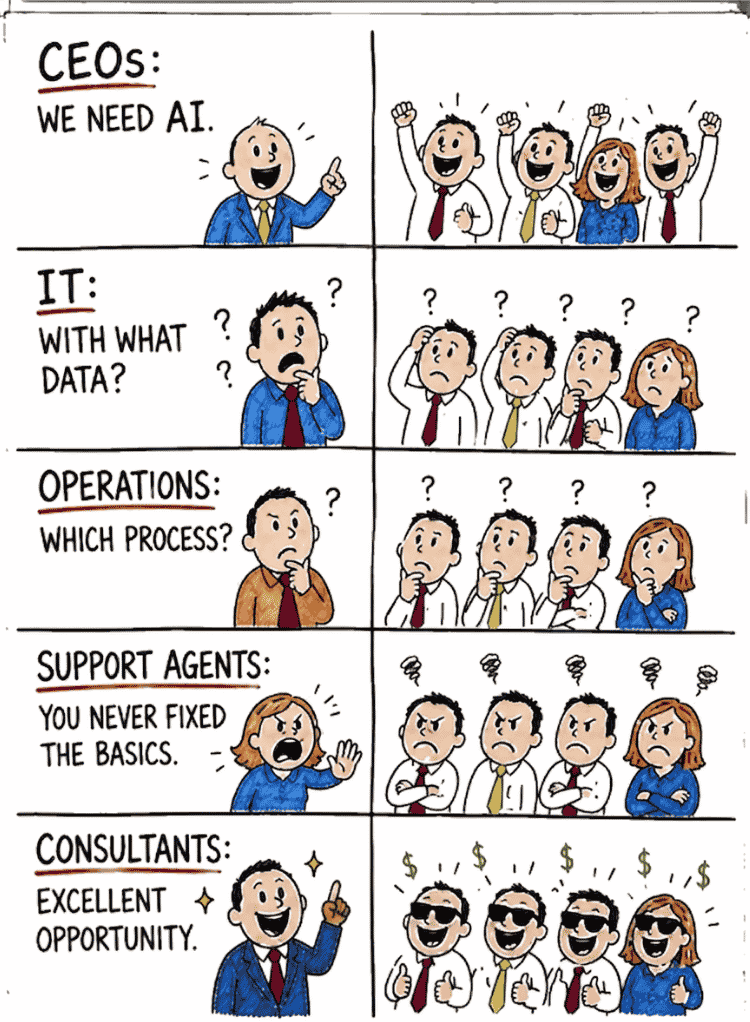
I came across this cartoon on LinkedIn recently and it immediately made me smile.
The CEO says: “We need AI.” IT asks: “With what data?” Operations asks: “In which process?” Support teams say: “You never fixed the basics.” And the consultants? They are already seeing an excellent opportunity.
It is funny because there is more than a little truth in it.
In my role as Head of Product at TCG Process, I spend a lot of time talking to stakeholders about AI, and the challenge I see most often is not a lack of ambition or even a lack of technology. It is the gap between the different parts of the organization that all need to come together to make AI useful in the real world.
Leadership wants the benefits of AI. IT needs to understand the data, architecture and governance. Operations needs to know where AI can actually improve a process. Support teams know that any automation eventually has to survive contact with real customers, real exceptions and real operational pressure.
That is why the cartoon resonated with me. The interesting question is not simply “How do we deploy AI?” It is how we connect all of those perspectives and turn AI from an ambition into something operational, measurable and sustainable.
From a product perspective, that is exactly where I believe OCTO fits.
OCTO is not simply a way of adding an AI model to a workflow. It provides the environment for the complete journey: helping Operations understand and automate the process, enabling IT to introduce the right AI and data technologies, giving support teams the controls needed to build robust production automation, and allowing leadership to deploy AI in a way that remains governed, explainable and measurable.
In other words, it helps move the conversation from “we need AI” to “this is where we are using it, this is why, this is how it is controlled, and this is the value it creates.”
And that journey starts with the question Operations is already asking.
Operations: “Which Process?”
AI conversations often begin with the technology. Operations usually starts somewhere else: what are we actually trying to improve?
Which activities create delays? Where are people manually rekeying information? Which decisions are repetitive? Where do cases fall between systems? Which steps genuinely need a person, and which could be automated? Before AI can transform an operation, the operation itself needs to be understood.
OCTO gives business and operational teams a visual environment for modelling the complete process, from documents and data arriving, through extraction, rules, integrations and automated tasks, to the points where people need to review, decide or intervene. This makes the process visible not only to developers, but to the people who own and operate it.
And Operations does not always have to start with a blank page. OCTO Accelerators provide pre-built starting points for common, repeatable processes, such as claims processing, digital mailroom, email triage, customer onboarding and invoice processing. They are designed to help teams move towards a working automation more quickly, while still allowing the process to be adapted to the organization's own requirements.
That distinction matters because it changes the starting point. Rather than deploying an isolated AI capability and then looking for somewhere to use it, organizations can begin with the business process and determine the right technology for each step. Sometimes that will be generative AI, sometimes document AI, and sometimes it will simply be a deterministic rule, an API call, a database lookup or a human decision.
The objective is not to maximize the amount of AI in a process. It is to build the best process, using AI where it genuinely improves the outcome.
Support Teams: “You Never Fixed the Basics”
Support teams often see the consequences of automation before anyone else. They deal with the exceptions, the awkward documents, the unexpected customer scenarios, the integration failures and the business rules that worked perfectly until reality presented something nobody had anticipated.
This is why production automation needs far more than a successful demonstration. It needs validation, exception handling, retries, monitoring, audit trails, human escalation and the ability to recover when something inevitably goes wrong. A process that performs beautifully with a handful of controlled examples is very different from one expected to handle thousands or millions of real-world transactions.
OCTO is designed around that reality. AI can be surrounded by deterministic controls, results can be validated before they move further through a process, and confidence or business rules can determine whether processing continues automatically or is routed to a person through Check and Act. Technical failures can be handled through alternative paths, while each stage becomes part of an operational record that can be monitored and understood.
The result is not simply automation, but robust automation: something designed to survive contact with the real world rather than only impress during a proof of concept.
IT: “With What Data?”
For IT and data teams, the question in the cartoon is equally legitimate. Traditional machine-learning projects have often started with a major data exercise: find thousands of representative examples, label them, clean them, structure them, train a model, evaluate it, retrain it and then build all the infrastructure required to put it into production.
For the right problem, that approach still makes sense. OCTO can support that journey because production processes themselves become a controlled source of useful operational data. Documents, outcomes, corrections, exceptions and human decisions can all contribute to understanding performance and, where appropriate, building or improving specialized models.
But the AI landscape now gives organizations another option. Zero-shot, few-shot and foundation models can perform increasingly useful classification, extraction, summarization and reasoning tasks without first creating enormous bespoke training datasets. This means organizations can start solving suitable problems much earlier, while continuing to gather better data for the areas where custom models will ultimately add value.
OCTO allows both approaches to coexist. Different models and services can be selected for different tasks, a specialist model can replace a general-purpose model when greater accuracy is needed, and new technologies can be introduced as the market evolves. Conventional technologies can continue to sit alongside AI instead of being replaced simply because something newer has appeared.
The important point is that the process remains the stable layer while the technology underneath it can evolve. In a market moving as quickly as AI, that is a significant advantage. Today's breakthrough model may be just another option on the list twelve months from now; the business process it supports will usually outlive it.
CEOs: “We Need AI”
The CEO in the cartoon is not wrong either. AI is creating genuine opportunities to rethink how organizations operate, but the danger lies in turning “we need AI” into a collection of disconnected experiments.
A chatbot appears in one department, a document extraction model in another, another team starts building agents, and somebody else introduces a separate cloud service for summarization. Before long, the organization has plenty of AI but very little understanding of how much it costs, what it is doing, where it is making decisions or what happens when something goes wrong.
OCTO provides a different route. AI becomes part of an orchestrated business process rather than an uncontrolled collection of technology calls. Organizations can define exactly where AI is allowed to act, which models can be used, what information they receive, when results require validation and when a human must become involved.
It also makes AI measurable. Volumes, processing times, exceptions, human interventions and outcomes can all be viewed in the context of the process delivering the business result. That helps organizations understand not only whether the technology works, but whether it is creating value and whether the cost of using it remains proportionate.
This becomes increasingly important as AI consumption grows. An uncontrolled collection of model calls can quickly become difficult to understand and expensive to operate. An orchestrated process gives organizations the opportunity to apply AI selectively, route simpler work through lower-cost technologies, introduce thresholds and human review where appropriate, and make the relationship between cost and outcome much more visible.
Just as importantly, OCTO helps answer one of the questions enterprises will increasingly need to ask: what actually happened?
For a particular claim, application, customer request or transaction, which technology processed it? What result did it produce? Which rule was applied? Was anything changed? Did a person intervene? What happened next?
That is the difference between simply using AI and being able to operate it in a safe, explainable and accountable way.
And the Consultants?
They will be fine.
Someone still has to create the transformation strategy, conduct the operating-model assessment, define the governance framework, establish the AI Centre of Excellence, build the implementation roadmap and produce the 147-slide presentation explaining how everything fits together.
There may even be a sizeable opportunity for an OCTO-enabled AI transformation practice.
So nobody needs to panic.
The Bigger Opportunity: AI Is Not the Destination
The more important point is that solutions should not be viewed purely as the provision of AI services. AI may be today's catalyst, but the underlying challenge facing organizations is much broader: they need to become considerably better at changing how they operate.
They need to connect systems without creating another generation of brittle point-to-point integrations. They need to automate repetitive work while keeping people involved where human judgement adds value. They need to adopt new technologies without rebuilding entire applications every time the technology landscape changes. They need processes that can be understood, measured, governed and continually improved, and they need to achieve all of this faster than traditional multi-year transformation programs typically allow.
That is why OCTO provides foundations not only for AI adoption, but for digital transformation, operational excellence and organizational agility.
Within the same orchestrated environment, organizations can combine visual process design, AI, deterministic rules, integrations and human work. They can select the right model for the right task, retain human-in-the-loop controls where decisions require oversight, and maintain the monitoring and auditability needed to prevent AI from becoming a black box. Reusable components and processes reduce the tendency for every new automation to become another bespoke project, while deployment flexibility allows organizations to work within their own security, infrastructure and data-residency requirements.
Perhaps most importantly, OCTO gives the different groups in the cartoon a common environment in which to work on the same problem.
The CEO can pursue the AI ambition. Operations can identify where it creates value. IT can provide the technology, data and governance. Support teams can make sure it survives contact with reality. And the organization as a whole can see whether any of it is actually working.
That is the real opportunity with AI. It is not about deploying the most models, creating the most proofs of concept or adding AI simply because everybody else is doing it. It is about using AI as part of a disciplined approach to building better processes: processes that are faster, smarter, safer, more adaptable and easier to improve.
The organizations that succeed with AI will not necessarily be the ones with the most AI.
They will be the ones that become best at putting AI to work.
And that is exactly the journey OCTO was built to support.
Ready to move from AI ambition to operational reality? Explore the OCTO Sandbox and experience how AI, automation, rules, integrations and human work come together in one governed process.
