Square Pegs, Round Holes: Why Rigid Systems of Record Are Holding Back Operational Efficiency
There’s a familiar pattern in most organizations.
You’ve invested heavily in core systems—ERP, CRM, policy admin, case management. They’re stable, trusted, and designed to hold clean, structured data. They are, quite rightly, the system of record.
And yet… operational efficiency still feels just out of reach.
Processes are slower than they should be. Exceptions pile up. People find “other ways” to get things done. Emails, chats, spreadsheets, even the occasional post-it note passed across a desk creating disconnected pockets of work that operate entirely outside governed processes.
It’s not because your systems are broken.
It’s because they’re being asked to do the wrong job.

The Problem: Forcing the Fit
Systems of Record are intentionally rigid. Their purpose is to enforce structure, maintain integrity, and act as the trusted source of truth across the enterprise. That rigidity is not a flaw, it’s what makes them valuable.
Of those responsibilities, integrity is the one no CIO will compromise on. Accurate, consistent, auditable data remains foundational to every decision, compliance obligation, and downstream process that depends on it.
But modern enterprise operations no longer behave in neat, predictable ways.
Documents arrive incomplete. Data originates from multiple channels. Processes span systems, teams, external services, and increasingly AI-driven interactions. Exceptions are constant, not occasional. Human judgment is often required before critical actions can move forward.
What Systems of Record are not designed for is handling messy, inconsistent inputs, adapting to constantly changing operational requirements, orchestrating multi-step cross-system processes, or managing human decision-making loops in real time.
A customer submits a simple change of address through an online portal. But behind the scenes, that update needs to reach multiple systems, each with different structures, validation rules, and ownership. Without a governed process layer coordinating the change, the same information gets re-keyed multiple times, inconsistencies emerge between systems, and operational teams are left chasing errors that should never have existed in the first place.
The same challenge appears when urgency enters the process. A workers’ compensation claim arriving late on a Friday, carrying potential penalty exposure if left unresolved over the weekend, cannot wait for a rigid workflow to catch up. The right person needs to act immediately, with full context, visibility, and the ability to make a decision before the delay becomes a business problem.
This is the core issue: modern operations are dynamic, unpredictable, and full of variability, exactly the kind of square pegs rigid systems were never designed to absorb directly.
When organizations try to force all of that variability straight into Systems of Record, the complexity doesn’t disappear. It spills out into the operation around them.
The result?
- Slow and expensive change cycles
- Overcomplicated system configurations
- Increasing reliance on manual workarounds
- Limited visibility into what’s actually happening
- In simple terms: you’re trying to force square pegs into round holes.
Where Inefficiency Really Creeps In
The real world isn’t structured. Documents arrive in different formats. Customers provide incomplete information. Exceptions are the norm, not the edge case. Processes span multiple systems, teams, and decisions.
When Systems of Record are the only place work can happen, something has to give.
So people adapt:
“I’ll just email that over”
“Let me fix this in Excel first”
“Can you quickly check this on Teams?”
Individually, these seem harmless. Collectively, they create:
- Fragmented processes
- Zero auditability
- Inconsistent outcomes
- Hidden operational risk
And ironically, the very systems designed to enforce control end up surrounded by uncontrolled work.
A Better Model: Protect the Core, Free the Process
The shift is simple, but powerful: Stop trying to make Systems of Record more flexible. Introduce flexibility around them instead.
Think of it like this:
- Systems of Record = the round holes (structured, controlled, stable)
- Real-world inputs = the square pegs (messy, unpredictable)
- Process automation = the layer that reshapes the peg before it fits
This process layer becomes the place where work actually happens: data is captured, enriched, and validated; decisions are made by people or AI; exceptions are handled properly; multiple systems are coordinated seamlessly.
Only once everything is ready does the data land in the System of Record, clean, structured, and compliant. Exactly as it should be.
Why Flexibility Drives Efficiency
When you introduce a flexible process layer, a few things change immediately:
1. You move faster—without breaking anything. New requirements, new rules, new integrations happen in the process, not the core system. That means quicker delivery and far less risk.
2. You eliminate the “shadow process” problem. Instead of work happening in emails, shared drives, messaging threads, and offline spreadsheets, everything is captured, tracked, and governed in one place. Tools like Teams and Slack have made informal coordination faster, but they’ve also made shadow processes harder to see and harder to control. Work fragments across more channels than ever, with no audit trail, no visibility, and no way to measure what’s actually happening.
3. You improve data quality at the source. Data isn’t forced into structure prematurely. It’s shaped, validated, and completed before it reaches the system of record.
A BPO serving corporate, government, and healthcare sectors achieved 99.95% accuracy on notoriously complex medical invoices by introducing a governed process layer between document intake and their core systems, replacing two costly legacy platforms in the process. Find out how they did it →
4. You gain full visibility and control. Every step, decision, and interaction is auditable. No more black holes.
5. You create a dynamic processing landscape. Processes can adapt based on inputs, context, and outcomes—connecting systems, people, and AI in a way that rigid platforms simply can’t.
In practice, that separation changes how the whole operation performs.
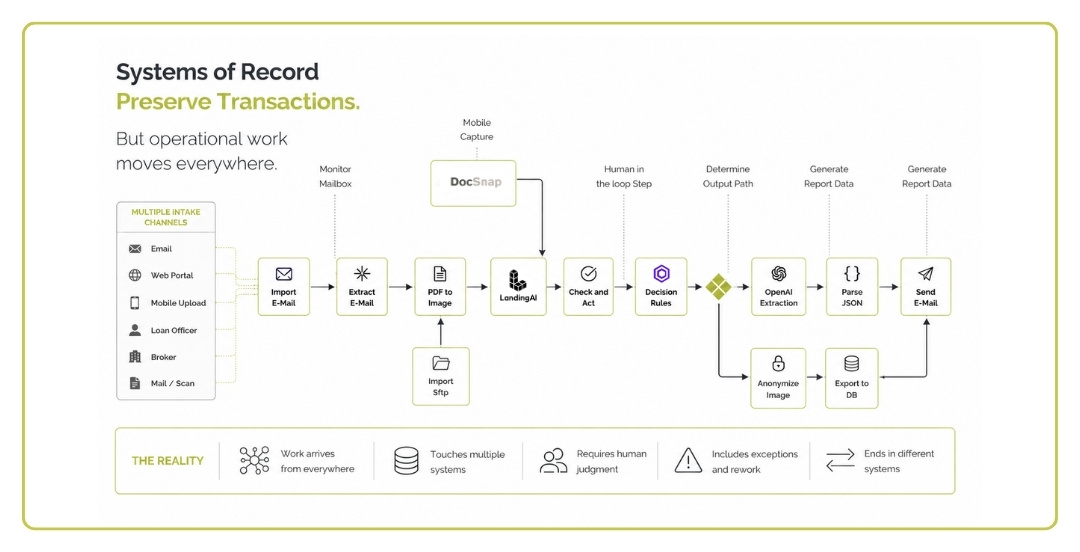
What This Looks Like In Practice
Take a few common scenarios.
Invoice processing. Suppliers send invoices in every possible format. A process layer extracts, validates, and enriches the data, only then posting clean entries into the ERP.
Claims handling. Submissions arrive incomplete or inconsistent. The process orchestrates document understanding, human review, and validation before updating core systems.
Customer onboarding. Data comes from multiple channels and formats. The process connects everything, resolves gaps, and ensures the CRM only receives high-quality, ready-to-use data.
Healthcare document management. In high-volume clinical environments, document-intensive processes touch every patient interaction. When capture, digitization, and archiving are governed by a dedicated process layer rather than forced through a system of record, the results speak for themselves.
A leading healthcare system processing millions of pages annually achieved 95% fully automated document processing, with records filed accurately without human validation. Find out how they did it →
In each case, the System of Record stays clean and controlled. The complexity is handled elsewhere, where it belongs.
The organizations seeing the greatest gains aren’t waiting for their core systems to evolve. They’re building the process layer around them.
Where Platforms Like OCTO Come In
This is where modern process orchestration platforms such as OCTO fit naturally into the enterprise landscape. Not as replacements for Systems of Record, but as the operational layer around them, connecting systems, people, documents, services, and AI into governed end-to-end processes.
The value comes from separation of responsibility. Systems of Record continue doing what they do best: maintaining trusted, structured, auditable data.
The orchestration layer handles everything else:
coordinating activity across multiple systems
managing exceptions and human decisions
adapting processes as requirements evolve
transforming and validating unstructured inputs
maintaining visibility and control across the entire operation
This is particularly important in document-intensive environments, where real-world inputs rarely arrive in a perfectly structured format. Instead of forcing complexity into core systems, platforms like OCTO create a controlled process layer where information can be interpreted, enriched, validated, and governed before reaching downstream applications.
The result is not simply faster automation. It is a more resilient operational model, one where organizations can evolve processes rapidly without constantly reshaping the systems designed to protect their core business data.
In many ways, this is the missing layer modern enterprises have been trying to build around their systems for years: the ability to connect structured systems with unstructured reality, without compromising either.
THE TAKEAWAY
Operational efficiency doesn’t come from forcing more into your Systems of Record. It comes from recognizing their role and protecting it. Let them do what they’re designed for: store clean, structured, trusted data. Then introduce a flexible, governed process layer that handles the mess, manages the flow, and adapts as things change.
The goal isn’t to make the round hole bigger. Looser fits only create gaps where inconsistency and operational risk creep in. The real goal is to mold messy, unpredictable inputs into something structured, governed, and ready to fit perfectly.
Your Systems of Record are doing their job. Let's make sure everything around them is too.
Talk to our team.
