The Logical Evolution: Why Modern Business Process Automation Belongs in the Cloud
Sergey Borovoy, Cloud Services Director at TCG Process, explores the case for delivering process automation in the cloud, and what changes when infrastructure stops being the bottleneck.
For many years, the "on-premise fortress" was the gold standard for enterprise technology. If you wanted security and control, you built it yourself, housed it in your own data center, and managed it with your own team. This model served its purpose in an era when business systems were largely internal and the "outside world" was something to be kept at bay. However, the demands of today’s market are forcing a re-evaluation of that physical control. This is not just a technical shift; it is a move from managing hardware to mastering workflows. By adopting a cloud-delivered intelligence layer, you free your team to focus on projects that directly support business growth while maintaining total control over your business outcomes.
Why Now?
For a long time, running business process automation on-premises was a reasonable choice. Business systems were largely internal, integrations were limited, and the cloud was still earning the trust of enterprise IT.
That environment has fundamentally changed. Organizations now rely on SaaS applications, AI services, remote teams, partner APIs, and ever-growing volumes of digital documents. Business processes routinely cross organizational and geographic boundaries, making infrastructure flexibility just as important as automation itself.
At the same time, business expectations have accelerated. New regulatory requirements, changing customer demands, and rapid advances in AI mean that organizations can no longer afford to spend weeks or months provisioning infrastructure before improving a process. Competitive advantage increasingly belongs to those who can automate, adapt, and deploy faster than their competitors. These trends make cloud-native Business Process Automation (BPA) not merely an alternative deployment option, but the architecture that best aligns with how modern organizations operate.
Connecting Your Business Silos
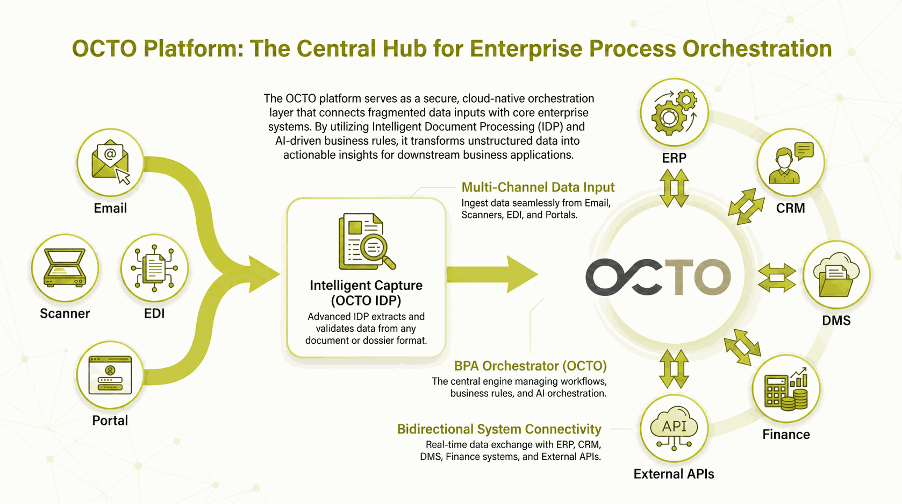
A common misconception is that a central orchestration platform must live in the same server rack as the data it manages. In reality, your business is already a distributed system. A cloud BPA platform connects your existing applications through APIs, allowing processes to span your ERP, CRM, email, document management systems, and third-party services without complex point-to-point integrations.
This cloud-native approach bridges the gap created by modern SaaS ecosystems and remote work. Instead of just helping ingest external data, the orchestration layer acts as a connectivity framework, securely managing information flow across your entire digital landscape. While some worry about "latency" - the delay imposed by the physical distance between the cloud and local servers – the associated data travel time is now measured in small fractions of a second. This is insignificant compared to the "thinking time" of business systems, which often take seconds to queue and process a task. In practice, the connection is essentially invisible, allowing your orchestrator to work in near-real-time with your existing systems.
Automating Processes, Not Just Tasks
Modern BPA begins where traditional enterprise systems stop. Instead of simply managing structured records, it captures and understands emails, invoices, PDFs, and other unstructured business content before routing it into automated workflows.
OCTO combines intelligent document processing, workflow orchestration, and AI-driven decision support in a single cloud platform. This allows organizations to automate complete business processes rather than isolated tasks. In this environment, AI does far more than just "read" text; it can classify incoming documents, extract key information, and validate it against your business rules. Importantly, it can detect anomalies to prevent fraud and duplicate payments, only routing exceptions to the right employees for review.
Because it’s delivered in the cloud, your team can move with "Journey Speed" - the ability to turn a new process idea into a live production outcome in record time.
Scaling at the Speed of Demand
You can only achieve this level of speed when you remove the physical friction of traditional IT. In an on-premises world, launching a new process often involves a month-long cycle of buying and configuring servers. In contrast, a cloud-based central automation platform can be deployed over the internet in hours.
This shift is the foundation of true organizational agility. In a market where digital document volumes can spike unexpectedly, you need the power to scale resources up for a new project or down after a seasonal peak without being stuck with "shelfware" or aging hardware you no longer need.
Security and Resilience at Scale
Major cloud providers invest billions annually in security, monitoring, and compliance capabilities that many organizations would find difficult to replicate internally. When properly configured, leading cloud platforms can provide security capabilities - including continuous monitoring, identity management, and encryption - that are difficult for many organizations to implement on-premises.
By delivering the OCTO platform via Microsoft Azure, we provide a level of resilience that regional hosting providers or small internal teams often struggle to match. In the cloud, high availability is built-in; if a server glitches, the provider instantly spins up a new instance to keep your work flowing. This infrastructure is supported by compliance tools like Vanta, giving you real-time insights into the security controls protecting your data.
The Iceberg of Ownership: Exposing Hidden Costs
The true cost of on-premise software is like an iceberg: the license fee is just the visible tip. Research from SysAid shows that maintaining on-premise systems can add 30–40% to your overall IT costs through hidden expenses like cooling, backups, and emergency repairs.
A major part of this is "The Hardware Refresh Loop." Physical hardware has a limited lifespan, typically estimated at 3–5 years. Recent data from the Gartner Peer Community confirms that IT leaders generally expect a 4–5 year lifespan for core server equipment. While some massive hyperscale providers are exploring extending these cycles to 5–6 years for environmental efficiency, the average enterprise remains stuck in a loop of periodic capital expenditures for equipment that merely maintains the status quo. In a cloud model, this hardware obsolescence is the provider's responsibility, not yours.

Maintaining Control and Compliance
For regulated industries like banking or insurance, where your data sits is a vital concern. While some believe on-premises is the only way to meet these rules, the cloud now offers better tools for residency compliance. Sophisticated cloud architectures use geofencing capabilities to route information based on local regulatory requirements, ensuring that sensitive data never leaves its mandated region. This allows you to maintain "operational sovereignty" - the power to design and control your own workflows - while using a global infrastructure built to handle complex, multi-jurisdictional rules.
Deployment Options
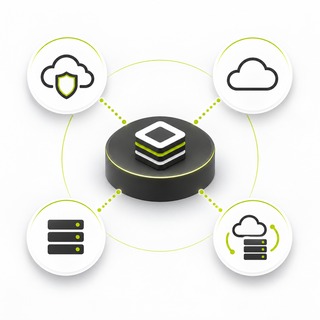
OCTO runs where your operations need it: in your own cloud, in a provider-hosted cloud, on-premises, or in a hybrid setup that combines them. The platform and its capabilities are the same in every case. This article makes the case for cloud delivery, but the choice of where OCTO runs stays yours.
Real-World Results
The organizations below operate in very different industries, yet they achieved similar results: faster processing, lower operating costs, and greater operational scalability:
• ERS (Insurance): This UK specialist motor insurer moved their claims intake to the cloud, reducing manual handling time from 25 minutes down to an average of 4 minutes per claim. This shift increased their overall claims input capacity by 75%.
• Barber’s (Food Manufacturing): A heritage cheesemaker automated their accounts payable, cutting invoice processing time from two weeks down to two days. This 85% reduction gave over 500 hours of capacity back to their finance team annually.
Conclusion: Mastering Your Operational Future
The real question is no longer whether business process automation belongs in the cloud. For most organizations, it is whether maintaining automation infrastructure still creates competitive advantage - or simply consumes valuable IT resources. By moving BPA to the cloud, organizations shift their focus from maintaining servers to improving business outcomes. That is where lasting competitive advantage is created. Delivered via the secure Microsoft Azure platform, OCTO as a Service provides the AI orchestration and connected automation needed to turn fragmented information into scalable results.